The History of Sutton-in-Ashfield, Nottinghamshire
Remembering Our Past, Preserving Our Heritage. From its medieval beginnings to its development as a centre of hosiery and coal mining, Sutton-in-Ashfield has a rich local history.
Before Sutton — Roman Discoveries
In 1849, railway construction near King's Mill uncovered a hoard of Roman silver coins. Other Roman coins and Romano-British pottery found in the area offer evidence of activity long before the medieval town developed.
Saxon and Medieval Sutton
Sutton-in-Ashfield is recorded in the Domesday Book of 1086 as Sutone. The name Sutton is generally understood to mean a southern settlement. The parish church of St Mary Magdalene retains medieval features, including work dating from the 12th century. Sutton developed as a farming and trading community.
The Manor House and Historic Mills
The old Manor House on Devonshire Square dates from the 17th century. Lindley's Mill on Prospect Place was built in 1820. In the 18th century, Samuel Unwin developed a textile mill using different sources of power, illustrating the area's early industrial ingenuity.
Framework Knitting and the Luddites
Framework knitting was an important occupation in Sutton by the 17th century. Stocking frames were used in homes and workshops, providing employment but also exposing workers to difficult conditions. In November 1811, during the Luddite disturbances, stocking frames were broken in Sutton-in-Ashfield as workers protested against threats to their livelihoods.
Hosiery and Pretty Polly
During the 19th and 20th centuries, hosiery became one of Sutton-in-Ashfield's best-known industries. The town was home to workshops and large factories producing stockings and knitted garments. Pretty Polly became nationally known for stockings and tights, and its Unwin Road factory provided local employment for many years. Production moved away in 2005.
Coal Mining and Working Life
Coal mining shaped Sutton-in-Ashfield and the surrounding Ashfield district. Sutton Colliery, also called Brierley Hill Colliery, began operating in the 1870s. Other nearby collieries provided employment for generations of families. The decline of mining in the 20th century changed the local economy and community life.
Railways and Trams
Railway connections helped move passengers, coal and manufactured goods. Sutton was served by several railway stations, including Sutton-in-Ashfield Town and Sutton-in-Ashfield Central. Electric trams began operating through the town in 1905, linking Sutton with Mansfield and Huthwaite; the tram service ended in 1932. Passenger rail access returned to the area with Sutton Parkway on the Robin Hood Line in 1995.
Market Place and the Town Centre
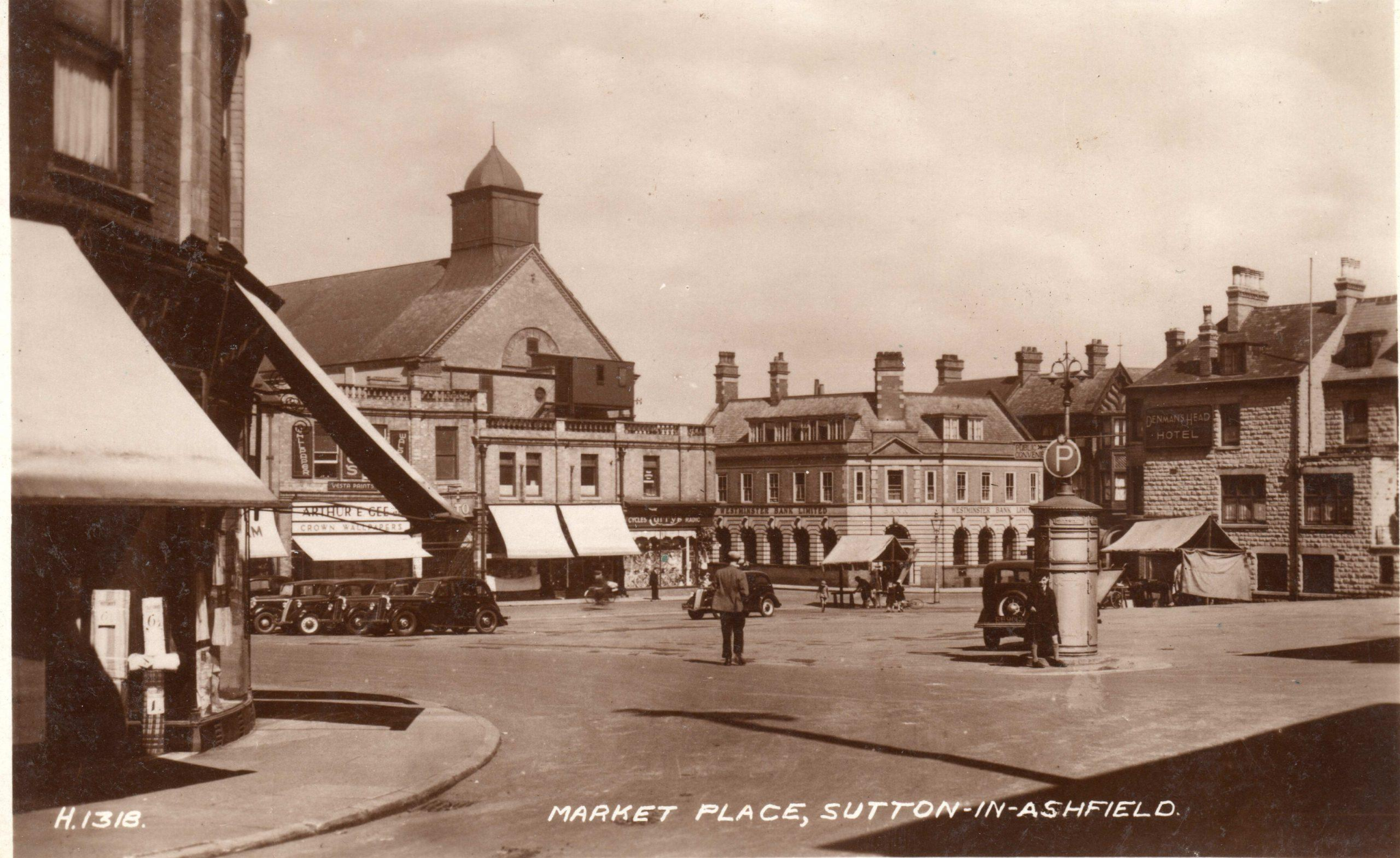
The Market Place has long been a centre of shopping, trading and community life. The Town Hall was built in 1888–1889. In 1905, buildings on the western side of the Market Place were removed to make the square more open. Old photographs show hotels, shops, early motor vehicles and the everyday life of the town.
Portland Square and the Village Green
Portland Square occupies an area connected with Sutton's historic village green. Earlier names associated with the area include Lower Green, Swine Green and Engine Green. These changing names reflect how the town's public spaces evolved.
Sutton-in-Ashfield During the Second World War
Residents supported the war effort through fundraising and service. Local fundraising contributed towards a Spitfire known as Silver Sniper, and the town adopted HMS Belvoir in 1942. The King's Mill site was used as an American military hospital during the war.
Population and Growth
Sutton's population expanded as manufacturing and mining developed. Historical figures record about 2,801 inhabitants in 1801, 6,542 in 1851 and 14,866 in 1901. Growth brought new housing, shops, schools and public services.
Historic Buildings and Landmarks
St Mary Magdalene Church, Lindley's Mill, the old Manor House, the Town Hall and other surviving buildings help tell the story of Sutton's medieval, industrial and civic past. Older streets such as Low Street, High Pavement and Outram Street also preserve connections with the town's commercial history.
Sutton-in-Ashfield Today
Sutton-in-Ashfield has changed considerably as coal mines and hosiery factories closed and new shopping, housing and public spaces developed. The Idlewells Shopping Centre became an important part of the modern town centre. Historic photographs, postcards, records and memories help preserve the people and places behind these changes.
Preserving Our Heritage
Every photograph, postcard, historical document and family memory contributes to the story of Sutton-in-Ashfield, Nottinghamshire. By preserving these records, we help future generations discover the industries, streets and communities that shaped our town.